

Key takeaways
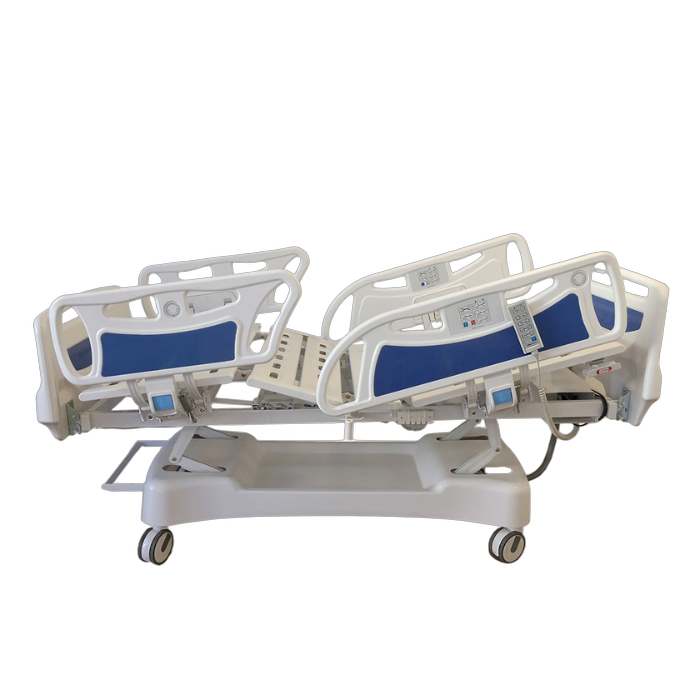
Configuration first: Manual, semi-electric, fully electric or bariatric - this choice determines your SWL range, positioning capability and staff manual handling exposure.
Safe working load (SWL): Standard beds cover 150-250 kg; bariatric beds cover 250-450 kg. Specify SWL to your ward's patient demographics, not your average patient weight.
If your ward manages high-acuity or post-surgical patients: fully electric with CPR quick-release, Trendelenburg positioning and nurse call integration is the minimum specification.
Side rail compliance: AS/NZS 3200.2.38 governs hospital bed safety including entrapment risk - confirm any bed meets current Australian standards before purchasing, especially used or imported units.
ARTG listing required: All hospital beds used in Australian clinical settings must hold a current listing on the Australian Register of Therapeutic Goods.
Infection control: Sealed mattress platforms, smooth weld seams and tool-free head/foot board removal are standard infection control specifications for acute care wards.
Price range (2026): $1,500-$30,000+ depending on configuration.
Choosing the right hospital bed for your ward: Configuration, specs and supplier guide (2026)
Hospital bed selection affects every hour of ward operation for the next 10-15 years - patient positioning, pressure injury prevention, staff manual handling risk, infection control compliance and emergency response capability all depend on getting the specification right at procurement. The most common purchasing error in Australian hospitals is specifying on price per unit rather than on ward acuity requirements, resulting in beds that either under-serve clinical needs or over-spec low-acuity areas at unnecessary cost.
This guide covers configuration selection, key specifications, compliance requirements and supplier evaluation for hospital beds in Australia. To compare pricing from verified suppliers, get quotes for hospital beds on MedicalSearch.
Facilities where bed specification decisions have the highest operational impact:
Acute care wards in public and private hospitals (medical, surgical, ICU)
Aged care and residential care facilities managing mobility and pressure injury risk
Rehabilitation and sub-acute facilities requiring progressive positioning capability
Day surgery and procedure recovery areas needing post-anaesthetic positioning
Choose your configuration
Before evaluating suppliers, confirm which configuration matches your ward acuity and patient population. Your choice here determines positioning capability, staff manual handling exposure and price bracket.
Type | Key Spec | Best For |
|---|---|---|
Manual | Hand-crank height, backrest, knee-break, 150-180 kg SWL | Low-acuity wards, aged care low-care, patient transport areas |
Semi-electric | Electric backrest + height, manual knee, 200-230 kg SWL | General medical wards, sub-acute, rehabilitation |
Fully electric | Full electric profiling, CPR release, nurse call, 230-250 kg SWL | Acute surgical, ICU, high-dependency, post-anaesthetic recovery |
Bariatric | Wide platform, reinforced frame, 250-450 kg SWL | Any ward managing patients above 150 kg regularly |
If your ward manages patients who require repositioning more than twice per shift, fully electric is the minimum specification. Semi-electric requires staff to manually crank the knee-break - an ergonomic risk on high-turnover wards.
Semi-electric suits you if your ward has stable, mobile patients who self-reposition and staff only adjust bed height and backrest angle during care episodes. This covers most general medical and rehabilitation settings.
Fully electric suits you if patients are immobile, post-surgical or require frequent position changes for pressure injury prevention, respiratory management or emergency CPR response. The most common mistake is specifying semi-electric for surgical wards to save $2,000-$5,000 per bed, then discovering staff cannot safely manage the repositioning load across a full shift.
Evaluate the key specifications
With your configuration confirmed, these are the specs that determine clinical suitability and operational durability.
Specification | Typical Range | Buyer Consideration |
|---|---|---|
Safe working load | 150-450 kg | Specify to your ward's heaviest patient demographic, not average - bariatric above 150 kg |
Height range | 300-800 mm platform height | Low height position (300-400 mm) reduces fall injury severity; high position reduces staff bending |
Backrest angle | 0-70 degrees | Cardiac and respiratory wards may require 80+ degrees for Fowler positioning |
Trendelenburg | ±12-16 degrees | Required for surgical, ICU and emergency wards - not needed for general medical |
Side rails | Split or full-length, folding | Must comply with AS/NZS 3200.2.38 entrapment requirements - split rails reduce entrapment risk |
Mattress platform | Mesh or solid with drainage holes | Sealed platforms with smooth welds are mandatory for acute care infection control |
Confirm your budget range
Hospital beds cost $1,500-$30,000+ in Australia depending on configuration and SWL. For fully electric beds at $6,000-$18,000, get quotes for hospital beds to compare pricing from verified Australian suppliers.
Plan the asset
The ATO effective life for hospital beds is 10 years and all standard configurations qualify for the $20,000 instant asset write-off.
Australian compliance requirements
Hospital beds in Australian clinical settings must meet these requirements:
TGA ARTG listing: all hospital beds must hold a current listing on the Australian Register of Therapeutic Goods before use in any clinical setting
AS/NZS 3200.2.38: hospital bed safety standard covering entrapment risk, side rail design, mechanical stability and labelling requirements
AS/NZS 3551: management programs for medical equipment including scheduled maintenance, electrical safety testing and performance verification
Infection control: sealed mattress platforms, smooth weld seams, tool-free head/foot board removal and chemical-resistant finishes are standard for acute care wards
Manual handling: WHS Regulations 2017 require risk assessment for patient repositioning - fully electric beds with profiling are a recognised engineering control
State health department requirements: NSW, VIC and QLD each have additional facility licensing standards that specify minimum bed capabilities for accredited wards
Evaluate suppliers
You are ready to go to market. Use this checklist to assess each supplier against the same criteria.
Factor | What to Ask |
|---|---|
ARTG listing | Provide the current ARTG number for this bed model. |
SWL and weight testing | What is the tested SWL and does it include mattress and accessories? |
Side rail compliance | Do the side rails meet current AS/NZS 3200.2.38 entrapment requirements? |
Infection control features | Is the mattress platform sealed? Are head/foot boards tool-free removable? |
Nurse call integration | Does this bed integrate with my existing nurse call system? |
Mattress compatibility | Which mattress types fit this platform - including alternating pressure systems? |
Training | Is staff training included on delivery and how many staff can be trained? |
Warranty | What is covered - frame, actuators, electronics, side rails? Duration? |
Service network | Do you have biomedical service technicians in my state for warranty and breakdown? |
Fleet demo | Can I trial beds on my ward for 2-4 weeks before committing to a fleet order? |
Frequently asked questions
When should a facility specify fully electric over semi-electric beds?
Any ward where patients require repositioning more than twice per shift should specify fully electric. Semi-electric requires manual cranking of the knee-break, which creates an ergonomic risk on high-turnover surgical and aged care wards.
What side rail standard applies to hospital beds in Australia?
AS/NZS 3200.2.38 governs hospital bed safety including entrapment risk from side rails. Split side rails that fold independently are the current best practice for reducing entrapment while maintaining fall prevention capability.
How do i confirm a hospital bed is ARTG-listed?
Search the TGA's ARTG database by device name or ARTG number. The supplier should provide the ARTG number on request. Used or imported beds must be independently verified against the current ARTG listing.
What infection control features should acute care beds include?
Sealed mattress platforms with no exposed fasteners, smooth weld seams, tool-free head and foot board removal, and chemical-resistant finishes that withstand hospital-grade disinfectants are the standard acute care specification.
Can i use the same bed specification across all ward types?
Specifying fully electric across all wards eliminates the risk of a semi-electric bed ending up in an acute bay, but it over-spends on low-acuity areas. Most Australian hospitals specify two tiers: fully electric for acute/surgical and semi-electric for general medical and rehabilitation.
What matters most
Configuration choice (manual, semi-electric, fully electric, bariatric) must be matched to ward acuity - not defaulted on price
SWL must reflect your heaviest patient demographic, not average weight
ARTG listing and AS/NZS 3200.2.38 side rail compliance are non-negotiable
Infection control features (sealed platform, tool-free board removal) are mandatory for acute care
Fully electric beds reduce manual handling incidents by 30-50% in documented trials
If you are within 6 months of a fleet replacement, get quotes now to compare fleet pricing, trial options and service network coverage
Most procurement managers shortlist 2-3 suppliers after a ward trial of 2-4 weeks.
Do not waste time contacting suppliers individually. MedicalSearch gives you direct access to verified Australian hospital bed suppliers - where medical buyers request and compare multiple quotes so they can buy with confidence.
Get quotes for hospital beds - contact multiple verified suppliers with a single enquiry
Compare models - filter by bed type, SWL and region
Contact suppliers directly - speak to specialists who service your state
→ Get and compare hospital bed quotes now →






(1)(1)-205x205.jpg)