
Key takeaways
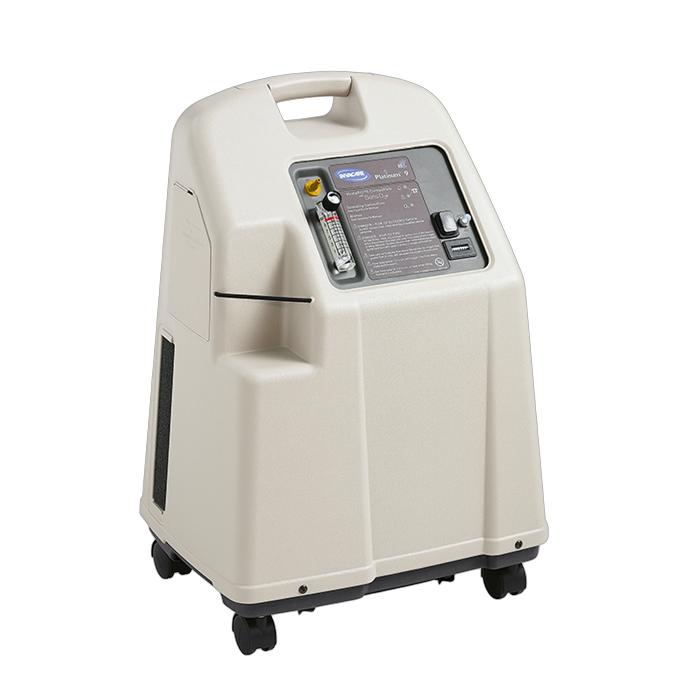
- Stationary concentrators (2026): 5L units $1,000-$2,500 AUD; 10L units $2,500-$5,500. Portable concentrators: pulse-dose $2,000-$3,500; continuous-flow $3,000-$5,000+.
- Flow delivery difference: Stationary units deliver continuous flow at 1-10+ LPM. Most portables deliver pulse dose only - not equivalent to continuous flow and not suitable for all prescriptions.
- If the patient needs oxygen during sleep: Choose stationary - most pulse-dose portables cannot detect shallow sleep breathing patterns reliably and will under-deliver oxygen overnight.
- Weight comparison: Stationary units weigh 14-32 kg (not portable). Portable units weigh 1.4-10 kg with battery operation for 2-8 hours.
- Cost gap: Portables cost 2-3x more than equivalent stationary units per LPM of output, with higher running costs due to battery replacement ($200-$500 every 1-2 years).
- Most home therapy patients need both: A stationary unit for overnight and in-home use, and a portable for outings and appointments - budget accordingly.
Stationary vs portable oxygen concentrator: Which configuration for your patient?
Stationary and portable oxygen concentrators both use pressure swing adsorption to concentrate ambient air into 90-96% purity oxygen, but they are designed for fundamentally different use cases. Stationary units plug into mains power and deliver continuous-flow oxygen at higher flow rates for extended use. Portable units run on rechargeable batteries and prioritise weight and mobility over flow capacity. In 2026, both categories are available on MedicalSearch, and specifying the right combination is the first clinical equipment decision for any home oxygen therapy programme.
This comparison is for home care providers, aged care procurement managers and respiratory clinic coordinators who need to determine whether their patients require stationary, portable or both - and what the cost and clinical implications are for each configuration.
Match the device type to the clinical requirement
Before comparing specs or price, confirm which oxygen delivery mode the prescription requires. This eliminates half the market immediately.
Factor | Stationary Concentrator | Portable Concentrator |
|---|---|---|
Oxygen delivery | Continuous flow (1-10+ LPM) | Pulse dose (most); continuous flow on select models (1-3 LPM max) |
Use during sleep | Yes - continuous flow is reliable overnight | Limited - pulse dose may not detect shallow breathing reliably |
Maximum flow rate | 5-10+ LPM | Pulse: setting 1-6; continuous: 1-3 LPM (select models only) |
Weight | 14-32 kg | 1.4-10 kg |
Power source | Mains AC only | Battery (2-8 hrs) + AC + DC (car) charging |
Noise level | 40-55 dB | 37-45 dB |
Price range (2026) | $1,000-$5,500 | $2,000-$5,000+ |
If the prescription specifies continuous flow at any setting, a stationary unit is required for home use. If the patient is mobile, active and prescribed pulse-dose oxygen for exertion only, a portable unit meets the clinical requirement. Most long-term home therapy patients prescribed both rest and activity oxygen need one of each.
Compare the key specifications
With the delivery mode confirmed, these specifications determine which specific model fits the patient's environment and lifestyle.
Specification | Stationary | Portable |
|---|---|---|
Oxygen purity | 90-96% at rated flow | 90-96% (drops at higher settings on some models) |
Battery life | N/A - mains powered | 2-8 hours depending on setting and battery size |
Annual electricity cost | $250-$550 | $30-$80 (charging only) |
Sieve bed life | 15,000-30,000 hours | 5,000-15,000 hours (smaller sieve beds) |
Battery replacement | N/A | $200-$500 every 1-2 years |
FAA approved for air travel | No | Most models - check specific airline approval lists |
The most common mistake is assuming a portable concentrator's pulse-dose "setting 3" equals 3 LPM continuous flow. Pulse dose delivers a bolus of oxygen per breath, and the actual volume varies with breathing rate. If a patient is prescribed 3 LPM continuous, a pulse-dose-only portable is not clinically equivalent without specific respiratory physician confirmation.
Compare the full cost (2026 prices)
Purchase price favours stationary units, but portables have higher ongoing costs due to battery degradation and smaller sieve bed capacity.
Cost Category | Stationary (5L) | Portable (Pulse-Dose) |
|---|---|---|
Machine purchase | $1,000-$2,500 | $2,000-$3,500 |
Annual running cost | $350-$500 | $300-$600 (batteries + filters) |
Battery replacement (per year avg) | $0 | $150-$300 |
3-year TCO | $2,500-$4,000 | $3,400-$5,800 |
For patients needing both home and mobile oxygen, the combined cost is $3,000-$6,000 upfront for a stationary + portable pair. This is still less than the 3-year cylinder equivalent of $7,500-$12,000. For current pricing across both categories, get quotes for portable oxygen concentrators alongside stationary quotes to compare the full pairing cost.
Decision framework - stationary vs portable oxygen concentrator
Decision Criteria | Stationary Wins | Portable Wins |
|---|---|---|
Continuous flow required | Yes - standard on all models | Limited to select models at 1-3 LPM |
Overnight/sleep use | Yes - reliable continuous delivery | No - pulse dose unreliable during sleep |
High flow rate (6-10 LPM) | Yes - 8-10L units available | No - max 3 LPM continuous on any portable |
Mobility and travel | No - mains powered, 14-32 kg | Yes - battery powered, 1.4-10 kg |
Air travel | No | Yes - most FAA-approved models |
Lowest purchase cost | Yes - from $1,000 | No - from $2,000 |
Lowest 3-year TCO | Yes - no battery replacement cost | No - battery adds $150-$300/year |
Evaluate suppliers
You are ready to go to market. Use this checklist to compare suppliers across both device categories.
Factor | What to Ask |
|---|---|
ARTG listing | Are both devices currently ARTG-listed? Provide the ARTG numbers. |
Paired pricing | What discount applies if I purchase a stationary + portable pair for the same patient? |
Battery availability | Are spare and extended batteries stocked in Australia? What is the replacement cost? |
Service network | Do you service both stationary and portable units in my state? |
Loan units | Do you provide loan units during servicing for both device types? |
Warranty alignment | What warranty covers each device? Are sieve beds and batteries excluded? |
NDIS/DVA | Are both models approved under the relevant equipment schedule? |
Trial period | Can the patient trial the portable unit before committing to purchase? |
Frequently asked questions
Can a portable concentrator replace a stationary unit for home use?
Only if the prescription is pulse-dose only and the patient does not require oxygen during sleep. For continuous-flow prescriptions or overnight use, a stationary unit is required.
Is pulse-dose setting 3 the same AS 3 LPM continuous flow?
No. Pulse dose delivers a bolus per breath, and actual volume varies with breathing rate. A respiratory physician must confirm whether pulse dose is clinically equivalent to the prescribed continuous flow rate.
Do i need two separate devices for a home therapy patient?
Most long-term home patients prescribed rest and activity oxygen benefit from both a stationary unit for home/overnight use and a portable for outings. Combined cost is $3,000-$6,000 upfront.
Which type is approved for air travel?
Most portable concentrators carry FAA approval for in-flight use, but each airline maintains its own approved device list. Confirm your specific model with the airline before booking.
What is the battery replacement cost for portable units?
Standard batteries cost $200-$500 and typically need replacement every 1-2 years depending on usage. Extended-life batteries cost more but reduce replacement frequency.
What matters most
- Delivery mode drives the decision: continuous flow requires stationary; pulse dose only can use portable
- Sleep-use patients need stationary - pulse-dose portables are unreliable overnight
- Portables cost 2-3x more per LPM and carry ongoing battery replacement cost
- Most long-term patients need a stationary + portable pair at $3,000-$6,000 combined
- Both devices must be ARTG-listed and prescription-matched before supply
Most providers shortlist paired configurations after comparing quotes across both categories.
Don't waste time contacting suppliers individually. MedicalSearch gives you direct access to verified Australian oxygen concentrator suppliers - where medical buyers request and compare multiple quotes so they can buy with confidence.
- Get quotes for stationary and portable oxygen concentrators - contact multiple verified suppliers with a single enquiry
- Compare models - filter by flow type, weight and region
- Contact suppliers directly - speak to specialists who service your state
Get and compare oxygen concentrator quotes now

-160x160-state_article-rel-cat.png)