
Key takeaways
- Recording duration: A resting ECG captures 10-30 seconds of cardiac activity; a Holter monitor records continuously for 24-72 hours (up to 14 days on extended models).
- Clinical scope: Resting ECG detects acute arrhythmias, ST changes and conduction abnormalities present at the time of recording; Holter detects intermittent arrhythmias, paroxysmal AF and symptom-rhythm correlation over days.
- Price gap: Resting 12-lead ECG machines cost $3,000-$15,000; Holter monitor systems cost $3,000-$8,000 per recorder plus $2,000-$8,000 for analysis software.
- Medicare billing: Resting ECG is billable under MBS Item 11700 ($26.05 per test); Holter monitoring is billable under MBS Item 11709 ($104.15 per recording and report) - Holter generates a higher rebate per patient episode (approximately 4× based on current MBS item values).
- Revenue per unit: A resting ECG at 8-12 tests/day may generate around $200-$300/day in MBS rebates; a Holter system with 3-5 recorders rotating may generate around $300-$500/day depending on utilisation.
- Consumable cost: Resting ECG electrodes cost $0.50-$1.50 per test; Holter electrodes and patient cables cost $3-$8 per recording - Holter consumables are higher per test but offset by higher rebate.
- Both sold on MedicalSearch: Welch Allyn, Edan, Philips, GE, Mindray (resting ECG); Philips, CardioScan, ECOMED, Spacelabs, APS Technology (Holter monitors).
Resting ECG machine vs holter monitor: Which should your practice buy first in 2026?
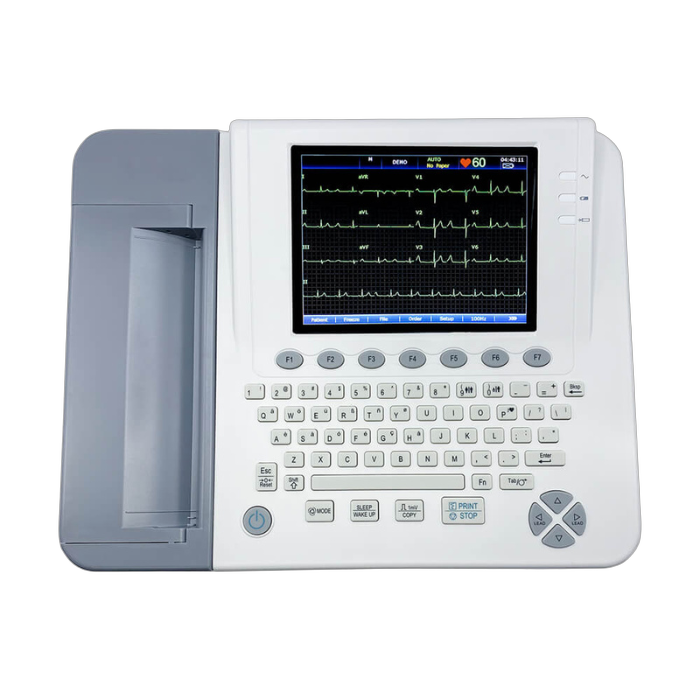
Most Australian GP practices, cardiology clinics and specialist rooms need both a resting ECG machine and a Holter monitoring system - but budget constraints mean one comes first. The resting ECG is the default because it is cheaper, faster to deploy and billable from day one. What most practice managers miss is that the Holter generates 4× the MBS rebate per patient episode, can produce a faster ROI at lower test volumes depending on utilisation and referral demand, and is better suited to detecting intermittent arrhythmias that may not be captured on a short resting trace. This guide compares both on cost, clinical capability and payback so the first-purchase decision is based on practice revenue reality, not unit price alone. For a broader overview of ECG machine selection, the ECG machine buying guide covers the full selection process.
This guide is for practice managers, clinic owners and procurement leads who are deciding which cardiac diagnostic to purchase first or next. Both are sold on MedicalSearch - get quotes for ECG machines and get quotes for Holter monitors once your priority is confirmed. Practices where this decision matters most include:
- GP practices adding cardiac diagnostics to reduce referral leakage and improve patient retention
- Cardiology clinics expanding monitoring capacity to reduce wait times for Holter appointments
- Specialist rooms in regional areas where patient travel time makes in-clinic resting ECG the preferred first-line test
- Aged care facilities adding cardiac screening capability for resident health monitoring
- Multi-practitioner clinics deciding whether to invest in shared ECG infrastructure or individual Holter recorders per GP
Understand the core difference
Before comparing cost and revenue, confirm which diagnostic fills the primary clinical gap in your practice. The difference is not quality - it is time: 10 seconds vs 24-72 hours of continuous cardiac data.
Factor | Resting 12-Lead ECG | Holter Monitor |
|---|---|---|
Recording duration |
10-30 seconds - single snapshot of cardiac rhythm |
24-72 hours continuous (up to 14 days on extended models) |
Clinical detection |
Acute MI, ST changes, conduction blocks, chamber enlargement - if present at time of recording |
Intermittent arrhythmias, paroxysmal AF, symptom-rhythm correlation, nocturnal bradycardia |
Test setting |
In-clinic, immediate result - patient on table for 5-10 minutes |
Ambulatory - patient wears recorder during normal daily activities and returns device after 24-72 hours |
MBS rebate |
Item 11700: $26.05 per test |
Item 11709: $104.15 per recording and report |
Interpretation |
Auto-interpretation + GP review - typically available immediately at point of care |
Analysis software + cardiologist report - turnaround typically ranges from same day to several days depending on reporting service |
Best first purchase for |
GP practices needing same-day cardiac screening at high test volume |
Practices where intermittent symptoms drive referrals and higher per-test rebate supports faster ROI |
TGA compliance |
Must be ARTG-listed - TGA Class IIa medical device |
Must be ARTG-listed - TGA Class IIa medical device |
Buy resting ECG first if your practice needs immediate, same-day cardiac screening at high volume (8-12+ tests/day), patients present with acute symptoms requiring point-of-care results, and most cardiac investigations are routine pre-operative or health check ECGs billable under Item 11700.
Buy Holter first if your practice regularly refers patients externally for Holter monitoring (leaking $100+ per referral in MBS rebates), intermittent palpitations and paroxysmal AF are common presenting complaints, and the 4× higher MBS rebate per test supports a faster payback on fewer daily tests.
Evaluate the key specifications side by side
With your clinical priority confirmed, these are the specifications that determine which specific model fits your practice's workflow and compliance requirements.
Specification | Resting 12-Lead ECG | Holter Monitor |
|---|---|---|
Lead configuration |
Standard 12-lead (10 electrodes) |
3-channel or 12-lead (3-10 electrodes depending on model) |
Data storage |
500-10,000 ECGs onboard; PDF/XML export to EMR |
24-336 hours continuous recording; download to analysis software |
EMR integration |
HL7/GDT/DICOM export available on most mid-range models |
Software-based - most systems export to EMR via HL7 or PDF report |
Patient throughput |
8-15 tests/day per machine (5-10 min per test) |
3-5 recordings/day per recorder set (limited by recorder count, not time) |
Consumables per test |
$0.50-$1.50 (disposable electrodes + thermal paper) |
$3-$8 (disposable electrodes + patient cable wear) |
Warranty |
1-3 years on unit; leads and cables are consumables |
1-2 years on recorder; software licences may be annual |
Full cost and revenue comparison (2026 prices)
The unit price is similar for entry-level models of both. The revenue per test and payback period are where the comparison diverges sharply.
Cost/Revenue Category | Resting 12-Lead ECG | Holter Monitor System |
|---|---|---|
Unit/system price |
$3,000-$15,000 (machine only) |
$3,000-$8,000 per recorder + $2,000-$8,000 analysis software |
MBS rebate per test |
$26.05 (Item 11700) |
$104.15 (Item 11709) |
Realistic daily volume |
8-12 tests/day |
3-5 recordings/day (with 3-5 recorders rotating) |
Daily MBS revenue |
$208-$312 |
$312-$520 |
Annual consumables |
$300-$800 |
$1,500-$4,000 (electrodes + reporting service fees if outsourced) |
Payback period |
2-4 months at 8+ tests/day |
2-4 months at 3+ recordings/day |
Both devices can pay back within a few months at realistic test volumes, depending on utilisation and billing patterns. The Holter generates higher daily MBS revenue at lower test volume - 3 recordings/day at $104.15 produces $312/day vs 12 resting ECGs at $26.05 producing $312/day. For an ECG machine at $3,000-$15,000, get quotes for ECG machines on MedicalSearch. For a Holter system at $5,000-$16,000, get quotes for Holter monitors on MedicalSearch.
Decision framework - resting ECG vs holter
Decision Factor | Buy Resting ECG First | Buy Holter First |
|---|---|---|
Primary clinical need |
Acute screening and routine cardiac assessment |
Intermittent symptom investigation and rhythm correlation |
Current referral pattern |
Referring for resting ECGs that could be done in-house |
Referring for Holter monitoring at $100+ per referral in leaked MBS revenue |
Daily test volume |
8+ resting ECG requests/day justifies the workflow setup |
3+ Holter requests/week justifies the recorder investment |
Revenue priority |
High volume at $26.05/test - revenue scales with test count |
Higher rebate at $104.15/test - revenue scales with fewer tests |
Staff capability |
Practice nurse can perform test - minimal additional training |
Requires trained staff for hookup + cardiologist or reporting service for analysis |
Evaluate suppliers
You are ready to go to market. Use this checklist to assess each supplier for either device type.
Factor | What to Ask |
|---|---|
ARTG listing |
Can you provide the ARTG listing number confirming TGA registration for this device? |
EMR integration |
Does this device export to our practice management software via HL7, GDT or PDF? |
Analysis/reporting |
For Holter: is analysis software included or separate - and do you offer a cardiologist reporting service? |
Consumable costs |
What is the per-test consumable cost - electrodes, paper, patient cables - and are these available from third parties? |
Recorder count (Holter) |
How many recorders do I need to run 3-5 recordings/day with a 24-72 hour recording cycle? |
Training |
Is operator training included in the purchase - and what does it cover (hookup, interpretation, software)? |
Warranty and calibration |
What is the warranty period - and what annual calibration or service is required? |
Finance |
Do you offer lease or equipment finance - and does the term include software licence renewals? |
Frequently asked questions
Which cardiac diagnostic generates a faster ROI for an Australian GP practice - resting ECG or holter?
Both pay back in 2-4 months at realistic volumes. Holter reaches the same daily MBS revenue with fewer tests (3 recordings/day at $104.15 vs 12 ECGs/day at $26.05) - making Holter the faster ROI for practices with lower daily test volume but consistent weekly referral demand.
Can a GP practice bill MBS for both resting ECG and holter monitoring on the same patient?
Yes - Items 11700 (resting ECG) and 11709 (Holter) are separate MBS items for different clinical indications and can both be billed for the same patient at different visits. A resting ECG for initial screening followed by Holter for intermittent symptom investigation is a standard clinical pathway.
What is the cost difference between in-house holter analysis and outsourced cardiologist reporting?
In-house analysis software costs $2,000-$8,000 upfront plus annual licence fees of $500-$2,000. Outsourced cardiologist reporting services charge $30-$60 per recording - at 3+ recordings/week, in-house analysis breaks even within 12-18 months.
Does a practice need both a resting ECG and holter, or can one replace the other?
They are complementary, not interchangeable. A resting ECG captures acute abnormalities present at the moment of recording. A Holter captures intermittent events over hours or days that a resting ECG will miss - a significant proportion of paroxysmal arrhythmias may not be detected on a single resting trace
What TGA compliance is required for ECG and holter devices in an Australian practice?
Both must be listed on the ARTG as TGA Class IIa medical devices. The practice must also comply with AS/NZS 3003 for medical electrical installations and maintain calibration records per the manufacturer's service schedule.
Summary
- Resting ECG captures 10-30 seconds of cardiac data - the correct first purchase for practices needing high-volume, same-day screening at $26.05 per MBS-billed test
- Holter monitoring captures 24-72 hours continuously - the correct first purchase for practices leaking $100+ per referral in MBS revenue on intermittent arrhythmia investigations
- Holter generates 4× the MBS rebate per test ($104.15 vs $26.05) and reaches equivalent daily revenue at one-quarter the test volume
- Both devices pay back within 2-4 months at realistic Australian practice volumes
- Both must be ARTG-listed TGA Class IIa devices - verify the ARTG number with the supplier before purchasing
Don't waste time contacting suppliers individually. MedicalSearch gives you direct access to verified Australian ECG and Holter monitor suppliers - where medical buyers request and compare multiple quotes so they can buy with confidence.
- Get quotes for ECG machines - contact multiple verified suppliers with a single enquiry
- Get quotes for Holter monitors - compare recording systems and reporting services
- Contact suppliers directly - speak to specialists who service your state
→ Get and compare ECG machine quotes now → https://www.medicalsearch.com.au/buy/ecg-machine
-160x160-state_article-rel-cat.png)


-160x160-state_article-rel-cat.png)

-160x160-state_article-rel-cat.png)