
Tilt Table

Join medical buyers comparing supplier quotes and buying with confidence. Free, quick and easy.


How MedicalSearch works
Tell us what you need
Answer a few quick questions about the equipment you're looking for.
Get personalised quotes
Receive tailored quotes from relevant Australian suppliers.
Compare and choose
Compare quotes, ask questions and choose the best option for you.
 Save time
 Compare quotes
 Buy with confidence
Save time, compare quotes & buy with confidence
Tilt Table | Physiotherapy & Rehabilitation Suppliers
Humans aren’t designed to spend months lying down or sitting in wheelchairs.
Legs accustomed to walking become weak as muscles and bones lay in limbo. Organs equally accustomed to operating in an upwardly mobile human body become virtual pancakes of horizontal disorientation and dysfunction. They too become difficult to return to an upright position without due care and attention.
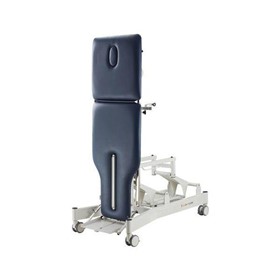
Tilt tables are a simple, yet ingenious device allowing doctors and medical specialists to gradually return patients to the perpendicular as their bodies readjust.
While strapped securely to a tilt table in the horizontal position, the patient can be slowly tilted vertically.
That’s why anyone reaching the end of a long injury or illness has to be eased out of a bed or wheelchair before they are back on their feet. Tilt tables allow gradual, incremental increases directly proportional to a patient’s physical and mental requirements.
Tilt tables can also be used for what’s called a Tilt Table Test to assess patients suffering from recurring faints.

HMG Direct & HealthMG have been providing high quality health, fitness & sports equipment for the past 20 years. Since starting in 1999 our range has expanded to well over 2000 different products; specializing in testing and monitoring equipment for the medical and performance markets. Our main clients include: Corporate Health, Dietitians, Exercise Physiologists, Gyms, ...

Our team comprehends the intricate and dynamic nature of allied health, recognizing that the clinical furniture and instruments employed daily by practitioners must meet the highest standards. LuxeMED's unwavering commitment to quality, reliability, and customer service positions us as a provider of exceptional medical equipment on which you can rely with confidence. The ...


- Diagnosing syncope: Tilt table testing can help diagnose the cause of fainting or syncope by monitoring changes in blood pressure and heart rate while the patient is tilted at different angles.
- Evaluating autonomic nervous system disorders: Tilt table testing can also help diagnose autonomic nervous system disorders such as postural orthostatic tachycardia syndrome (POTS) by measuring changes in heart rate and blood pressure.
- Treating orthostatic hypotension: Tilt table therapy can be used to treat orthostatic hypotension, a condition in which blood pressure drops when standing up. By gradually increasing the angle of tilt, the body can adapt to the change in position and improve blood flow.
- Improving circulation: Tilt table therapy can also improve circulation in patients with spinal cord injuries or other conditions that limit mobility.
- Some of the safety features of a tilt table include:
- Safety straps: The patient is secured to the table using safety straps to prevent them from falling or slipping off the table during the tilting process.
- Emergency stop button: The tilt table is equipped with an emergency stop button that can be used to immediately stop the tilting process in case of an emergency.
- Gradual tilting: The tilt table tilts slowly and gradually, which allows the patient to adjust to the changes in position and reduces the risk of injury.
- Adjustable speed: The speed of the tilting process can be adjusted to suit the needs of the patient and the condition being treated.
- Monitoring equipment: The tilt table is equipped with monitoring equipment such as blood pressure monitors, ECG machines, and pulse oximeters to monitor the patient's vital signs during the tilting process.
Tilt Table Costs and Supplier Insights
Buy a Tilt Table Near Me

 Reach valuable medical buyers in minutes
 Promote key products & content
 Drive cost effective & measurable sales