
Vital Signs Monitor

Join medical buyers comparing supplier quotes and buying with confidence. Free, quick and easy.








How MedicalSearch works
Tell us what you need
Answer a few quick questions about the equipment you're looking for.
Get personalised quotes
Receive tailored quotes from relevant Australian suppliers.
Compare and choose
Compare quotes, ask questions and choose the best option for you.
 Save time
 Compare quotes
 Buy with confidence
Save time, compare quotes & buy with confidence
Vital Signs Monitor & Spot Monitor Suppliers
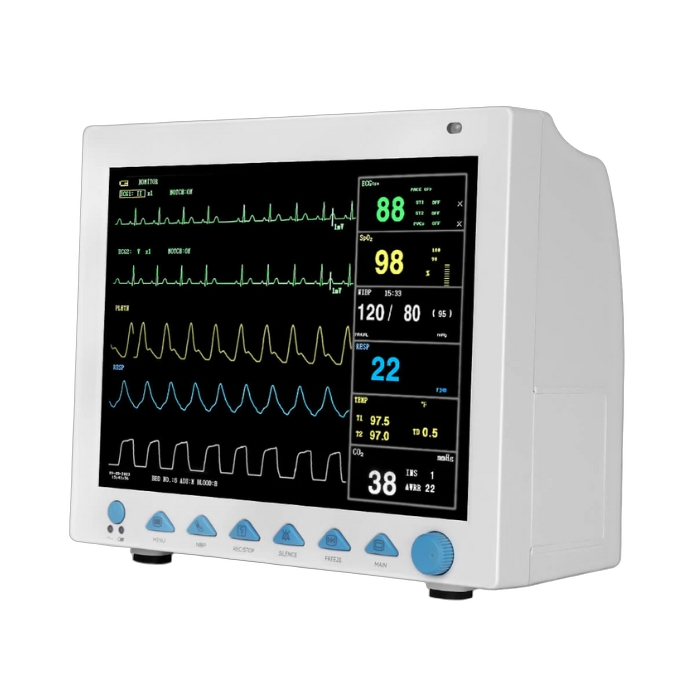
Vital signs monitors or patient monitors have been around for quite some time, and for good reasons. They help monitor vital signs in the human body, such as heart rate, blood pressure, oxygen saturation levels, and body temperature.
Vital signs monitors and patient monitors are mainly designed for use by doctors to evaluate a patient’s health and diagnose medical conditions. They are used for monitoring a patient’s health without requiring constant supervision.
Many health problems have common symptoms and can be hard to detect and treat without these monitors. The monitor provides a constant update to the doctors, and in case of an irregularity, immediately sounds an alarm.
Millions of hospitals rely on vital signs monitors and patient monitors to monitor patients’ health. They come with sensors that collect the data and use a display to show these readings; different sensors measure different vital signs.
Doctors can use the charts produced by vital signs monitors to determine a patient’s overall condition and recommend treatments accordingly.
Founded in 1991, Mindray is one of the leading global providers of medical devices and solutions. Firmly committed to our mission, we employ advanced technologies and transform them into innovation adapted to clinical scenarios, bringing healthcare within reach with our sound global R&D, marketing and service network. While improving the quality of care, we make it more accessible ...

Mindray Vital Signs Monitor | VS 9

Mindray Vital Signs Monitor | VS 8

Mindray VS 9 Vital Signs Monitor
HPA, is a market-leading provider of healthcare solutions to Hospitals, Day Surgeries, Clinics and Aged Care across Australia and New Zealand. Renowned for innovation and excellence, HPA has grown over the years to become one of the most trusted names in the healthcare industry. What makes HPA stand out is the global partner network of leading brands coupled with superior ...
Customers: Monash Health, ACT Health, Hollywood Private Hospital, Westmead Hospital, Northern Health


LSR has 50 years combined experience in clinical and commercial healthcare. Based in Sydney, Australia, we supply Medical Products and Patient Monitors to Australia and New Zealand healthcare providers. We provide a high level of thoughtful service to the healthcare industry, illustrated by bringing to market new products like the newly released TOF3D by MIPM and the Mindray ...

- Blood pressure: This is a measure of the force of blood against the walls of the arteries. High blood pressure can lead to serious health problems such as heart disease and stroke.
- Heart rate: This is the number of times the heart beats per minute. A normal resting heart rate for adults is between 60 and 100 beats per minute.
- Respiratory rate: This is the number of breaths a person takes per minute. A normal respiratory rate for adults is between 12 and 20 breaths per minute.
- Oxygen saturation: This is the amount of oxygen in the blood. A normal oxygen saturation level is between 95% and 100%.
- Temperature: This is a measure of the body's internal temperature. A normal body temperature for adults is between 98°F and 99°F.
- Multi-parameter monitors: These monitors can measure multiple vital signs simultaneously, including blood pressure, heart rate, respiratory rate, and body temperature.
- Blood pressure monitors: These monitors measure the systolic and diastolic blood pressure using a cuff placed around the upper arm or wrist.
- ECG monitors: These monitors measure the electrical activity of the heart and can detect abnormal rhythms.
- Pulse oximeters: These monitors measure the oxygen saturation level in the blood by attaching a clip to the finger or earlobe.
- Thermometers: These monitors measure body temperature using various methods such as oral, ear, or forehead.
- Accuracy: The monitor should provide accurate readings for blood pressure, pulse rate, oxygen saturation, and temperature.
- Ease of use: The monitor should be easy to operate and have a user-friendly interface.
- Portability: The monitor should be lightweight and compact, making it easy to move from one location to another.
- Connectivity: The monitor should have the ability to connect to other devices or software for data sharing and analysis.
- Battery life: The monitor should have a long battery life to ensure continuous use throughout the day.
- Durability: The monitor should be built to withstand frequent use and potential drops or impacts.
- Cost: The monitor should be reasonably priced for its features and functionalities.
Vital Signs Monitor Costs and Supplier Insights
If you are looking to buy a Vital Signs Monitor for sale, suppliers on MedicalSearch include Mindray Medical Australia, Hospital Products Australia
Buy a Vital Signs Monitor Near Me
Vital Signs Monitor Articles & Reviews
-
![]() Buying guide
Vital Signs Monitor vs Patient Monitor: Which Does Your Facility Actually Need? (2026 Comparison) in Vital-signs-monitor
Read guide
-
![]() Buying guide
Vital Signs Monitor Prices and Buying Guide for Australia in Vital-signs-monitor
Read guide
-
![]() Buying guide
Essential tips for setting up a medical clinic in Australia: Your complete guide in Vital-signs-monitor
Read guide
-
![]() Buying guide
Patient Monitor Buying Guide: Selecting the Right Monitor for Comprehensive Patient Care in Vital-signs-monitor
Read guide
-
![]() Buying guide
Troubleshooting and Common Issues with Patient Monitors: Tips for Timely Resolution in Vital-signs-monitor
Read guide
-
![]() Buying guide
Innovations and Future Trends in Patient Monitoring Technology: Advancing Healthcare Outcomes in Vital-signs-monitor
Read guide



 Reach valuable medical buyers in minutes
 Promote key products & content
 Drive cost effective & measurable sales